


Updated August 2025
Reward-based and equity crowdfunding enable U.S. entrepreneurs and company owners to take orders for products or trade shares for investment capital. Who would have thought in 2000 that it would be possible for business owners to raise seven-figure sums from people they didn’t know, or even have as a customer? The vital stepping stone in this timespan was the sometimes massive sums raised on reward crowdfunding platforms. However, early backers of reward-based projects are unable to invest directly in the companies, they can only acquire their often innovative products. Reg CF crowdfunding platforms allow individuals to own equity in privately-owned businesses. Here are 10 top U.S. reward and Reg CF crowdfunding platforms.
A similar review of 15 top crowdfunding platforms in Europe is available, including reward, equity, P2P lending and real estate platforms. It was updated in November 2025.
Reward-based crowdfunding
Kickstarter is the world’s largest reward crowdfunding platform. It was launched on April 28 2009 in New York as an alternative way to raise funding for performance arts projects and productions. Its model was to encouraging low value donations from a large group of people rather than a lot of money from a few individuals.
It quickly expanded to cover many other hobby, craft and product categories. As at mid-August 2025, almost 284,000 successfully funded projects have raised over £9 billion from a total of 24.5 million backers (the figures are updated daily by Kickstarter).
It has an “all or nothing” policy meaning projects that fail to reach their target don’t receive any funding and the backers who made pledges don’t pay anything. Successful projects pay a 5% commission plus up to 3% transaction charges.
Indiegogo actually launched first, in January 2008 in San Francisco, again as an alternative way to raise funds for arts projects. Indiegogo also quickly grew to host projects in many other different categories.
A significant difference is that Indiegogo allows projects to receive the money that’s pledged even if they fail to reach target. Prior to July 2025, their regular 5% commission rose to 9% for projects that did not reach target, plus there were always transaction fees of approximately 3% on every project.
This changed in July 2025, when Indiegogo was acquired by the Polish crowdfunding platform Gamefound, which up until then had focused on funding for board games. Both platforms will continue to exist separately, though Gamefound campaigns will now be featured on both platforms. Indiegogo will now also accept a wider range of payment methods, which will enable it to expand its operations into more countries. Indiegogo also immediately changed its pricing to a flat 5% fee.
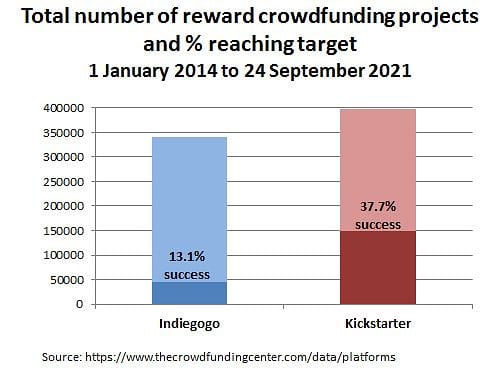
From 1 January 2014 to 24 September 2021, Kickstarter hosted more projects than Indiegogo: 397,426 vs 340,586 (as measured by crowdfundingcenter.com). Kickstarter projects also had a higher success rate of 37.7% compared to 13.1%
These two broad scale platforms dominate the US reward crowdfunding market. To have a point of difference, the next largest platforms focus on specialist business sectors.
Patreon was founded in 2013 and is the world’s largest crowdfunding site specifically for artists and creators. Creators can choose to launch their own digital shop and obtain funding from their fans or patrons per creation, or run a paid membership to earn funds on a recurring basis. It is particularly popular with YouTube content creators, musicians, and webcomic artists. There are two scales of platform fees. For creator pages published before 4 August 2025, the fees range from 5% to 11%. For creator pages newly published since August 4, Patreon charges creators a standard 10% fee based on the money raised. There are also transaction charges that vary from 2.9% to 3.9%, depending on the methods of payment used. There may also be currency conversion fees, and where required by law, Patreon collects relevant taxes on platform fees.
Seed&Spark is an industry specific crowdfunding platform for the tv and film industry, and is based in Los Angeles. It launched in December 2012 and within an overall aim to build an independent film community it provides filmmakers with a reward-based crowdfunding facility. By mid-August 2025, the platform had raised $77.8m from 223,346 backers to help fund 6.412 new movies and shows. The platform claims an 82% success rate.
Projects must reach a minimum 80% of target to keep the money pledged by backers. With less than 80%, projects risk taking on more than they can achieve, and possibly waste the backers’ money. Seed&Spark charges a 5% fee on successful projects, though provides project backers with an opportunity to add this fee to their pledge. Many choose to do so, and on average the crowdfunding projects themselves pay just under 2% of funds raised to the platform.
Seed&Spark’s CMO helped us with an article on making and crowdfunding independent films.
Reg CF equity crowdfunding
Title III of the JOBS Act which came in to effect in May 2016 extended online equity crowdfunding opportunities to Americans earning under $200,000 per year through Reg CF, though set limits on the amounts that could be invested. New platforms were launched to provide a full online equity crowdfunding facility to this wider non-accredited market, whereas previous ones serving higher net worth individuals (“accredited investors”) generally required transactions to be made offline.
From March 2021 the U.S. Securities and Exchange Commission eased the regulations, and Reg CF projects can raise up to $5m. Limits on how much an unaccredited investor can pledge in a year remain in place, though are calculated in a different way which widens the pool of potential investors.
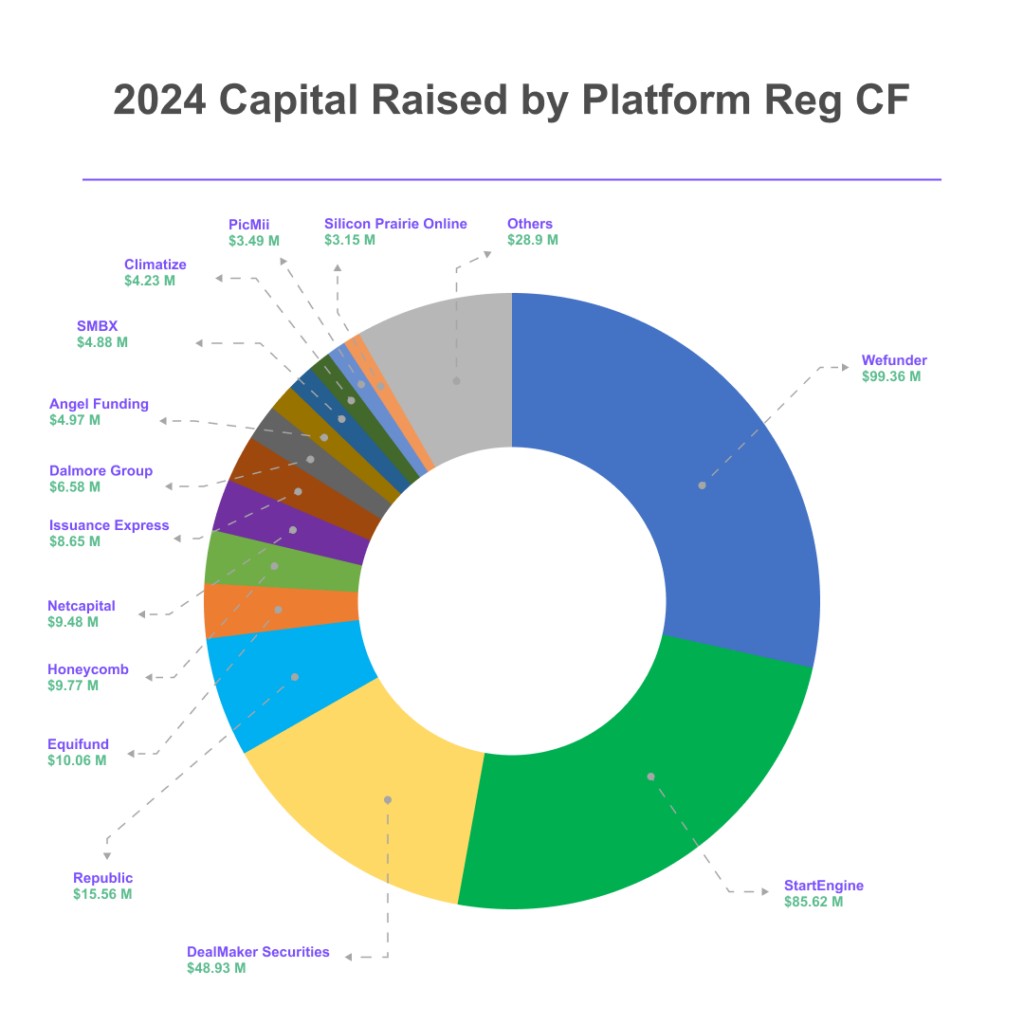
In 2024, companies utilizing Reg CF raised a total of $343.6 million, which was 18% down compared to the $423 million raised in 2023. Equity-based offerings generated $303.4 million (88%) of investment volume, while Debt-based offerings received $40.2 million (12%) of investment volume. The total number of projects listed in 2024 was 1,408, which was less than 3% lower than 2023’s 1,448. The average investment size in 2024 was $1,500 – a 26% increase on 2023’s $1,190. This data was compiled and previously published by Kingscrowd.
Source: Kingscrowd
Raising money by trading shares through equity crowdfunding is just one element of it. Many company founders talk of the benefits of being able to more closely involve top customers, of building a community of supporters, and the marketing exposure a well-crafted equity crowdfunding campaign can deliver. These ideas are expanded on in an article of “Crowdsourcing Dos and Don’ts.”
By individual platform, Wefunder has been the U.S. Reg CF crowdfunding market leader since it launched in 2012. The minimum investment size is $100, and Wefunder has created internal Investor Clubs in order that part-time investors in its network can access the wisdom and leadership of more experienced and professional investors, and combine their investments with them on equal terms. In 2024, the platform raised $99.36 million
StartEngine, which is based in LA and launched in June 2015, was in the second place spot. Investors can start taking equity in a business through StartEngine from as little as $100. In 2023, StartEngine acquired the assets of its rival SeedInvest, and the platform generated $85.62m of investment through Reg CF in 2024.
Third place in 2024’s Reg CF fundraising went to DealMaker Securities, which raised $48.93m. DealMaker works with clients to raise investment funding through all possible routes, and entered the Reg CF sector in July 2022. These top three platforms (Wefunder, StartEngine and DealMaker) between them accounted for 67% of the total Reg CF funding raised in 2024.
Since we looked at this sector in 2021, Republic has drifted out to a distant fourth place in the platform rankings. It generated $15.56 in 2024 in the U.S. However, during this time, Republic acquired the prominent UK equity crowdfunding platform Seedrs in December 2021 in a deal valued at $100m, and Seedrs was relaunched as Republic Europe in July 2024. Through registration under the European Crowdfunding Service Providers Regulations (ECSPR), Republic Europe is licensed to raise funds both in the UK and across the 27 member countries of the European Union.
Three U.S. Reg CF crowdfunding platforms raised around $10 million each in 2024: Equifund, $10.06m; Honeycomb, $9.77m; and Netcapital, $9.48m.
- Equifund is open to accredited and non-accredited investors, and offers vetted investment opportunities in privately-owned companies across sectors like real estate, healthcare, and AI.
- Honeycomb gives individuals opportunities to invest in local small businesses that are seeking loans to fund growth.
- Netcapital has enabled retail investors to support privately-owned businesses since 2016.
What U.S. equity crowdfunding costs
If an equity crowdfunding project is unsuccesful there are generally no fees to pay. Successful ones are charged a percentage of the amount raised. Prior to running equity crowdfunding activity, businesses usually also face legal fees to authenticate company documents. Investors may be charged a small fee, which is added to their investment figure. There may also be a ‘carry over’ arrangement whereby the platform will retain a small proportion of any profit made on an investment when it is liquidated.
We’d like to hear if you have any experience of directly ordering products through reward crowdfunding, or investing in businesses through any of these U.S. equity crowdfunding platforms. Do you have any comments or insights you’d like to share?
Crowdfunding Prize in BOLD Awards VII, 2026
Have you been involved, or will you soon be involved, in a crowdfunding project that deserves to win an international award at a glittering gala dinner ceremony?
Boldest Crowdfunding Project is one of 22 categories of digital industries and the technology that powers them. BOLD Awards VII is now open for entries, at an Earlybird processing fee of just €49. Entries can be revisited and upgraded at any time up to the final deadline in December 2025, even after the Earlybird period closes. Judging will begin with a round of public voting in January 2026, and continue with assessments by an international panel of judges, leading to a prestigious award ceremony for all finalists on 27th March, 2026, in Barcelona in Spain.
Check out the entry requirements and how to enter now!


Great that you were able to come up with the list. The industry certainly has grown and changed since this was last posted. There are many more platforms and solutions available to the crowdfunding community
Nowadays crowdfunding industry is coming up with many such readymade tools & scripts which helps developed a crowdfunding platform within a matter of minutes.
When I researched it I came up with really exciting tool which Like to share with the readers : www[dot]fundraisinscript[dot]com