


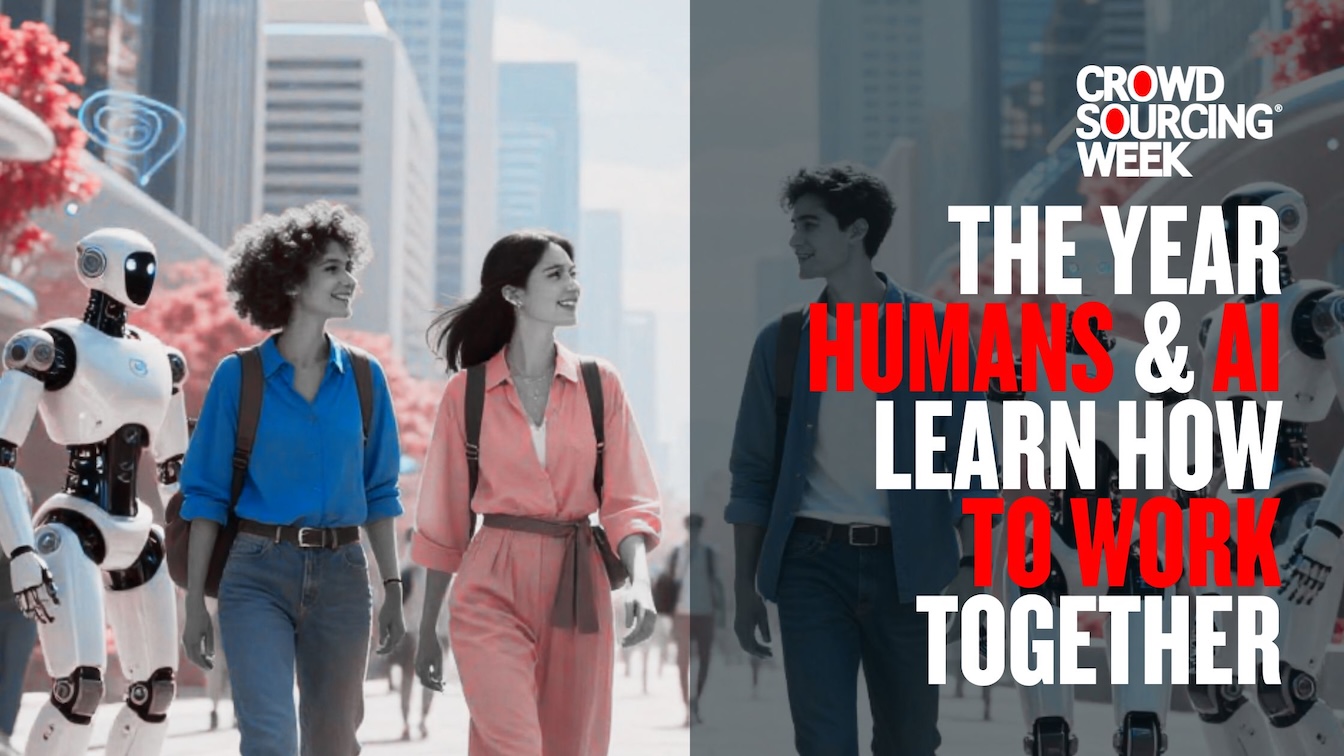
This is Crowdsourcing Week’s theme for 2026.
For the past several years, artificial intelligence has been framed as a binary confrontation: humans versus machines; automation versus employment; creativity versus code. Leaders have moved between excitement and anxiety, repeatedly asking the same question: will AI replace us? But that framing misses the point. The defining story of this decade is not replacement, it is redesign. It is human AI collaboration to create hybrid intelligence systems.
If 2023 and 2024 were about experimentation, and 2025 was about deployment, then 2026 will be more significant: the year augmented collaboration becomes operational doctrine. Rather than debating whether disruption is coming, the organizations pulling ahead are actively redesigning how intelligence is structured inside their systems. Not human intelligence on its own, nor artificial intelligence operating in isolation. It is hybrid intelligence, built intentionally at the intersection of humans, machines, and crowds.
This shift changes everything. Powerful AI tools are quickly becoming accessible to everyone, and competitive advantage will not come from simply having the best model. It will come from orchestrating participation at scale, building systems where AI amplifies human expertise, crowds expand insight, and governance sustains trust.
From Automation to Augmented Human AI Collaboration
The first wave of AI adoption focused heavily on automation. Processes were streamlined, costs reduced, and productivity improved. In many cases, AI was added as a performance layer on top of existing workflows.
However, while automation improves efficiency, it does not automatically increase intelligence, and most complex roles cannot be fully automated. Many complex roles can have roughly 30% of their tasks automated, and while AI can assist with analysis, drafting, prediction, and pattern recognition, the remaining 70% requires fundamental human expertise and oversight covering accountability, ethics, and final judgment.
The next phase introduced AI as a co-pilot, helping individuals work faster and more effectively. What is emerging now goes further. AI is being embedded into collective systems where its effectiveness depends on structured human participation and distributed input. Augmented collaboration is therefore not about splitting tasks between people and machines, it is about amplifying collective intelligence in hybrid intelligence systems.
In such hybrid systems, crowds contribute diversity, lived experience, and contextual nuance; AI scales analysis and detects patterns across vast data sets that would have previously overwhelmed purely human assessors; human experts provide judgment, direction, and ethical oversight. Together, these three elements form adaptive intelligence networks, and success will depend on designing the most effective orchestration system. We shall revisit this during the year as more organizations move beyond pilots toward fully integrated hybrid models to deliver superior outcomes.
Human-in-the-Loop as Infrastructure
As AI systems mature, one fact that is becoming increasingly clear is they do not function effectively without structured human participation. Modern AI systems improve through reinforcement learning from human feedback, continuous validation, distributed moderation, and iterative refinement. These are not optional add-ons; they are foundational infrastructure. Models improve because humans guide them, remain reliable because humans correct them, and stay relevant because humans contextualize them.
This fundamentally reframes crowdsourcing. It is no longer a “nice to have” engagement strategy, it becomes a mission-critical layer of the AI stack. Forward-looking organizations are embedding continuous feedback loops into everyday workflows: AI drafts outputs; humans validate and refine them; external communities contribute additional context. Distributed contributors effectively become quality assurance networks.
AI systems are consequently only as intelligent as the ecosystems that sustain them. Throughout 2026, we shall revisit how participation design becomes just as strategic as model design.
Designing Adaptive Intelligence Systems
Organizations are moving beyond isolated AI pilots and building continuous intelligence systems where internal crowdsourcing platforms are enhanced by AI-driven filtering and synthesis. External ecosystems, such as startups, universities, and creators, are being integrated directly into digital workflows. Distributed reporting networks feed real-time signals into machine learning systems that support predictive action.
Innovation is then no longer the responsibility of a single department; it becomes a networked capability as part of a company’s DNA. The organizations that succeed in 2026 may not have the most sophisticated standalone AI, though they will have adaptive intelligence network systems capable of absorbing diverse input, synthesizing insight rapidly, and responding dynamically to change.
This directly affects resilience. Disruptions can expose how fragile centralized decision-making can be, whereas distributed (decentralized) intelligence systems scale insight collection, accelerate feedback loops, and diversify risk exposure.
They are consequently about much more than just productivity; they are about vital adaptability in uncertain conditions. This is a theme we shall revisit during the year as resilience continues to shape strategy.
Governance as Competitive Strategy
As human AI collaboration deepens, governance will become more central to questions around data ownership, compensation and reward, bias, transparency, and accountability. They are no longer peripheral, and the answers will determine long-term viability.
Trust architecture is becoming as important as technical architecture. Without sustained participation, AI systems degrade. Without transparency, adoption slows. Without fair incentives, engagement declines.
Hybrid intelligence systems cannot rely solely on extraction — drawing value from contributors without reciprocity. For these systems to thrive, value must flow in both directions.
Governance therefore becomes a competitive differentiator, not simply a compliance obligation. Similar to other factors, we shall revisit this governance as competitive strategy during the year as organizations experiment with new incentive models, attribution systems, and participatory governance frameworks.
Intelligence as a Collective Asset
2026 will not be remembered as the year AI surpassed human intelligence. Instead, it will mark the year organizations recognized that intelligence itself is collective.
The most successful enterprises will stop asking whether AI can replace humans. Instead, they will focus on designing systems where humans and AI elevate one another in a symbiotic relationship. AI amplifies scale and speed. Crowds expand perspective and context. Humans provide meaning, judgment, and accountability. When these forces are integrated intentionally, intelligence becomes a shared, evolving asset.
This is our defining theme of 2026. Throughout the year, we shall revisit this transformation as augmented collaboration reshapes innovation, governance, resilience, and competitive strategy across industries. And we want your inputs to make this an on-going dialogue.

0 Comments