


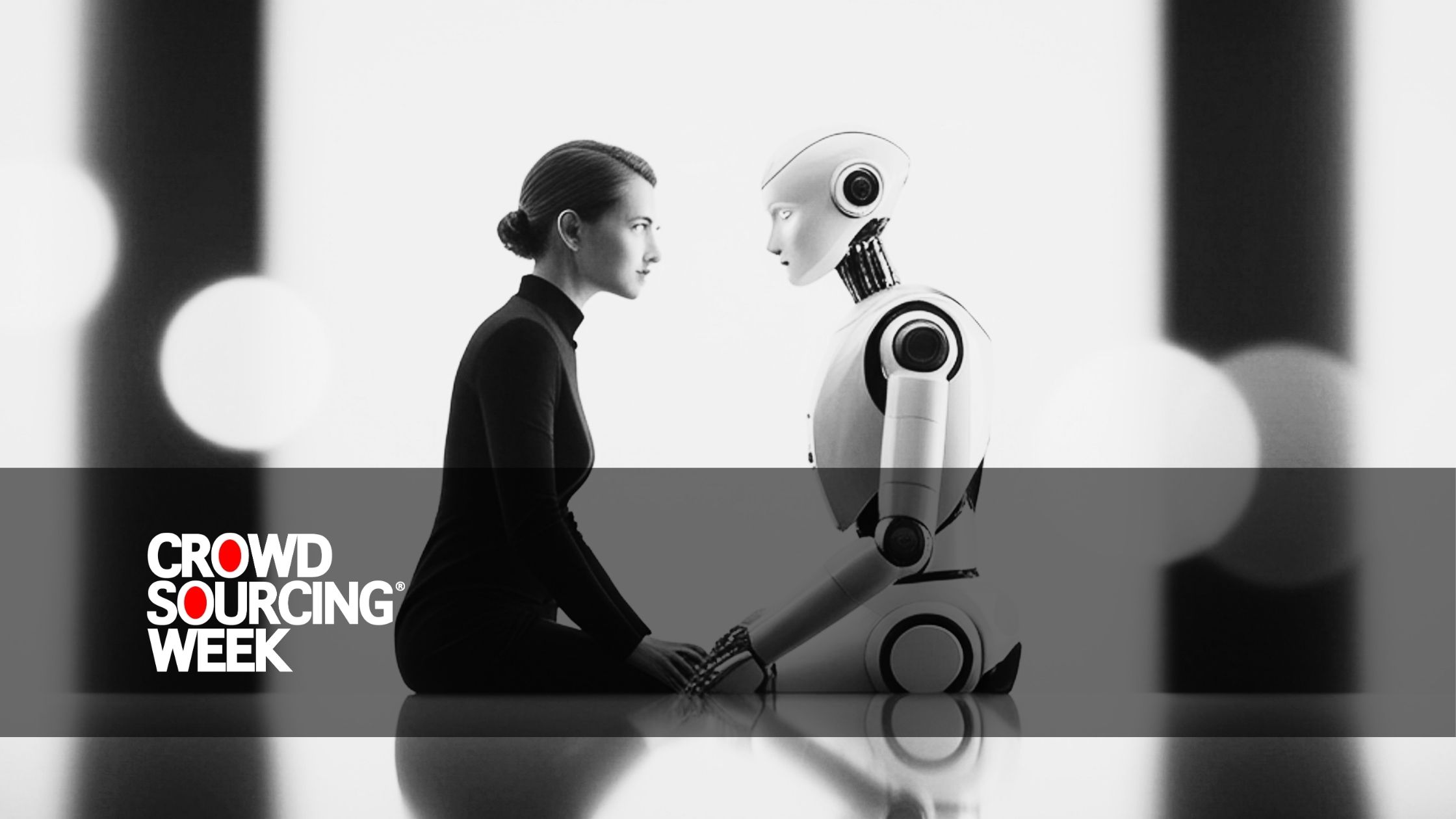
Thinking Machines’ “interaction model” just might solve the problems of real-world human-to-AI interaction.

Mira Murati, founder of Thinking Machines
Some of the best technology ever created is being compromised by an AI human bottleneck. It’s not a hardware issue or an intelligence issue. This is a conversation issue. And a research paper this month from AI lab Thinking Machines makes an interesting argument that it will need to rethink the very architecture of how AI models are created to solve it.
They make a simple point: the best AI models of today are designed for autonomy, not collaboration. The stronger they get, the more they eliminate humans from the equation.
Indeed, one frontier model card (a comprehensive governance and transparency document accompanying leading-edge AI systems) even acknowledged this directly. It claims it has better performance in “autonomous, long-running agent harness” than in interactive, hands-on-keyboard scenarios where humans remain involved.
Thinking Machines is not convinced. They suggest the solution is a so-called interaction model.
Why Turn-Based AI is a Collaboration Bottleneck
The current AI human bottleneck is due to how AI actually has a conversation. It waits. You speak or type, and the model is silent until you’re done. Then it responds, and no information will come from you at all during that response. It can’t see that you’re getting a little nervous, respond to the content you’re seeing on the screen, or step in to fix a mistake while you’re talking.
This is a very important consideration in real-life situations. Most useful things that need to be done are not completely defined in advance. Good collaboration involves keeping abreast of what’s going on, real-time adaptation, and catching miscommunication early.
Turn-based models, no matter how intelligent, can’t do that. What this means is that people are being pushed out of the human-AI loop, not because they’re not needed, but because there’s no room for them in the interface. This contributes to the AI human bottleneck.
Creating Interactivity Within the Model
The majority of the current real-time AI systems are known as a “harness”. External components are stitched together to give turn-based models the appearance of responsiveness. The issue is that a harness is only as smart as its dumbest part.
A very poor turn detector can be placed behind a very good language model, and the result will be a system that mishears, interrupts at the wrong time or that doesn’t pick up on any cues.
The interaction model is different. It does not process full turns, but rather “micro-turns”: pieces of audio, video, and text that are continuously and interleaved processed in 200 millisecond chunks. This means the model is always in the position of perceiving and responding simultaneously. It can detect if the speaker is thinking, yielding or inviting for a response without requiring an additional component to do the detection.
The architecture combines this real time interaction model with a background model that addresses more complex reasoning tasks asynchronously. Users receive the depth of thinking from a thinking model and the responsiveness from a lightweight model. The AI human bottleneck gets quite narrow.
In practice, the potential this unlocks is very real. The model doesn’t have to be prompted to break in, but can when there is something wrong. It can convert speech on the fly, while the speaker is still speaking. It can respond to visual signals, like seeing a coding mistake on the screen, even if the user doesn’t point it out.
It also has an inbuilt sense of elapsed time, which can enable real-time coaching and time-managed task management capabilities.
Thinking Machines applied these capacities to benchmarks they designed to reflect these dimensions, since there were no other benchmarks that were designed to test these aspects of interactivity.
When it comes to tasks such as starting speech at user-requested timings, responding to verbal cues during speech, or answering questions based on a specific visual cue in a video stream, the competitor models were pretty much unable to do anything. They stayed silent, or gave answers untethered from what was actually happening in real time.
Compared to standard intelligence benchmarks, TML-Interaction-Small is competitive with non-thinking frontier models, and is far superior in responsiveness and interaction quality.
Why Organizations Should Pay Attention Now
Today, most enterprise AI deployments take the approach that AI is best when it works alone: give it a task, let it do its work, check the results. That helps with clearly defined and limited work. It’s less effective for messy, iterative, judgment-intensive tasks that create value in most organizations.

AI is more like a colleague next to you than a sophisticated document processor. Source: Unsplash
The models of interaction suggest another paradigm, one in which the AI human bottleneck is considered a structural issue that can be solved with an architectural solution.
Yet AI is not just a sophisticated document processor – it’s more of a capable colleague sitting next to you, who can ask a clarifying question when needed, see something on your screen, or continue a conversation wherever it left off.
The paper is honest in admitting what has yet to be resolved. These are all cited as open challenges: long sessions, compute demands, and real-time alignment. The present model is a 276-billion-parameter mixture-of-experts model, which is still too big to be deployed in most enterprise environments. Thinking Machines admits this.
The Bigger Picture: AI, Humans and the Power of the Crowd
Even if it’s not stated outright, the best innovations don’t often happen in stand-alone systems. They are from networks. Communities. Crowds. Human feedback is the next, more refined, step after intelligent systems shape and refine what humans do.
This is where crowdsourcing comes in, and why it’s more relevant in the AI age than ever.
The interaction model is intended to help keep humans meaningfully in the loop with one AI system. Apply this principle to scale it up, and a more transformative option emerges.
What if AI that can truly work collaboratively in real time is put into the hands of not only one person, but thousands? Instead of one expert and one model, what if it was communities of practitioners, customers and domain experts continually developing and refining what the AI learns and performs?
This is the actual power of AI and crowdsourcing when combined. Not AI taking the place of human judgment but AI augmenting collective intelligence in ways that neither humans nor AI could do alone.
The crowd provides diversity of perspective, lived experience and contextual knowledge that no training data set can fully capture. AI provides speed, pattern recognition and availability without tiring. When combined with the appropriate interface in between, they are capable of becoming much more than the sum of their individual components.
The firms that grasp this early will create the next generation of products, employees and innovation ecosystems. They will not treat AI as an independent entity and give it jobs and leave it to itself. They will experience it as an active member of a much larger collaborative network where human intelligence, crowd intelligence and machine intelligence are continually reinforcing.
The future is not about the termination of human beings by AI. It’s about humans, AI, and the crowd, all working in tandem and on a large scale.
One step is to address the AI human bottleneck at the architectural level (which is what Thinking Machines is trying to do). The next one is linking that enhanced human-AI collaboration to the greater power of collective intelligence.
The Collaboration Design Question
This research raises an issue that organisations should be asking themselves now: are the AI tools you are using designed for human-AI collaboration, or are they designed to replace the human in the loop completely? They are not identical and they have very different results.
In most organizational settings, AI is not the answer to eliminate human judgment. It is derived from the addition of it. This only works if the interface is designed to involve the human, not to put them on the sidelines. That engaged human is most effective when plugged into a larger network of collective intelligence, rather than being a solo effort.
It’s a very early stage. The interaction model is a research preview and not a product. However, it is a true change in the way AI researchers think about collaboration, and it is something to watch carefully if an organization is serious about deriving actual value from human-AI teaming.
Which aspect of the AI human bottleneck resonates most with your own experience? Are you already exploring ways to combine AI collaboration with crowdsourced input in your organisation? We’d love to hear what you’re finding.

0 Comments