


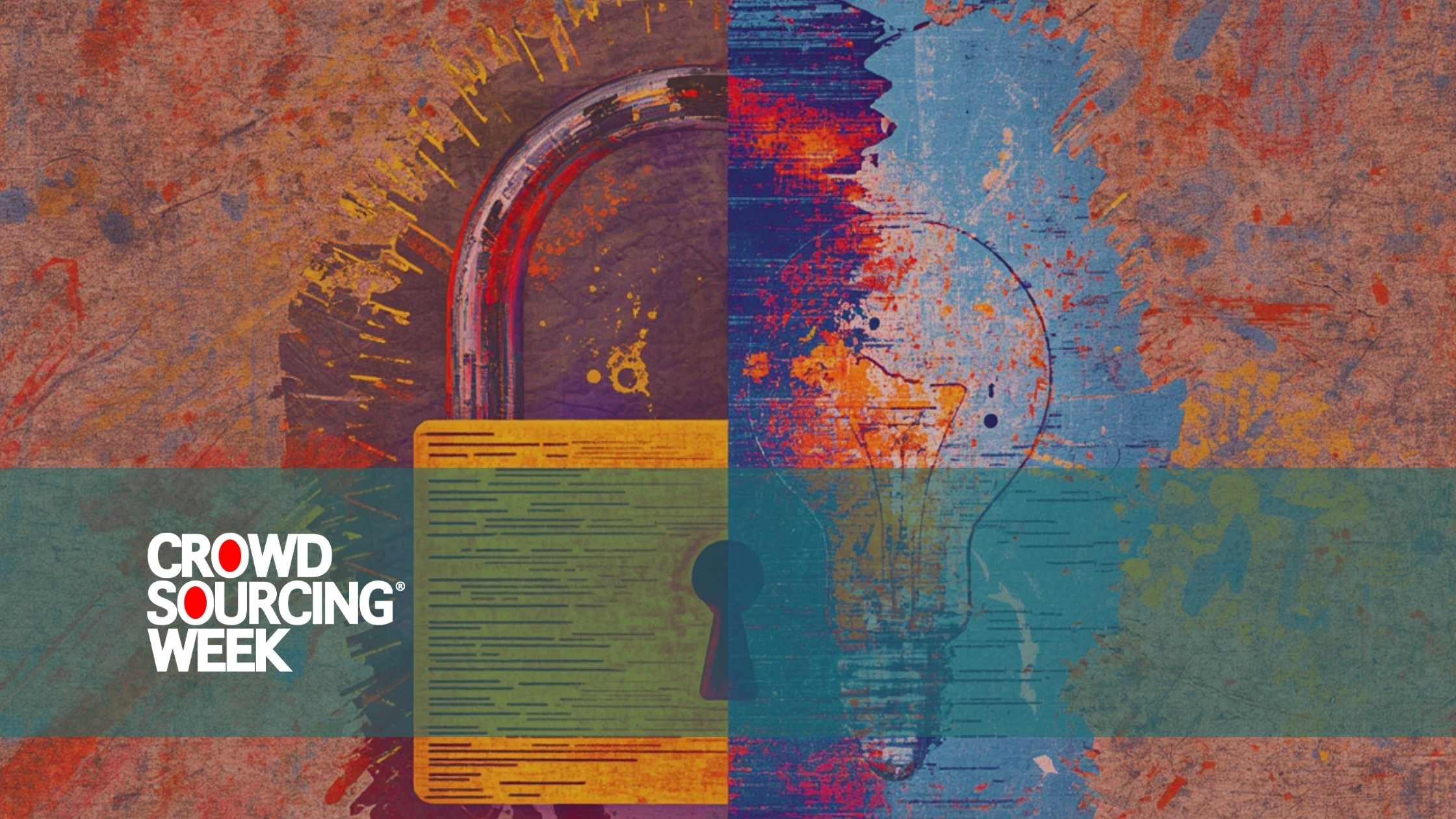
How forward-thinking organizations are rebuilding their innovation infrastructure around collective intelligence, and why those that don’t may find themselves running on outdated software.
Crowd-driven innovation at scale is the new operating system for the 2020s. Every decade or so, enterprise gets a new operating system. Not the kind that runs on servers, but the kind that runs the business itself: the underlying logic of how decisions get made, how problems get solved, and where good ideas come from. In the 1980s, that operating system was process efficiency. In the 1990s, it was data. In the 2000s, it was connectivity. In the 2010s, platforms and ecosystems took centre stage. We’re now in the early stages of the next shift, crowd-driven innovation at scale. The organizations that recognize it early will have a structural advantage that compounds over time.
What “Crowd-Driven Innovation” Actually Means
Let’s be precise, because this phrase can sound vague if left undefined.
Crowd-driven innovation is the practice of systematically tapping distributed networks of people, whether employees, customers, partners, external experts or the general public, to generate, refine, and validate ideas that solve real business problems. It’s not a suggestion box. It’s not an annual hackathon. It’s an organizational capability that is built into how the enterprise operates.
The distinction matters. A one-off crowdsourcing initiative can produce a good idea. A crowd-led innovation capability produces a continuous pipeline of them, informed by diverse perspectives, tested against real-world feedback, and aligned to strategic priorities.
When we talk about crowd-driven innovation as an “operating system,” we mean that it becomes the default infrastructure for how an organization thinks, learns, and adapts, rather than an occasional add-on.
Why Now? The Forces Making This Inevitable
Three converging pressures are pushing enterprises toward crowd-led models, and the convergence is accelerating.
Complexity has outgrown the hierarchy. The problems enterprises face today (climate risk, AI integration, geopolitical supply chain disruption, shifting consumer behavior) are what complexity theorists call “wicked problems.” They don’t have clean solutions. They require input from people with radically different vantage points. A leadership team, however talented, simply does not have enough cognitive diversity to navigate them alone. Research from the Harvard Business Review has consistently shown that diverse problem-solving groups outperform homogeneous expert groups, especially on novel challenges.
Talent is now distributed, not concentrated. The assumption that the best thinking lives inside your organization’s walls was always questionable. It’s now indefensible. Remote work, the gig economy, and global digital connectivity mean that expertise is available anywhere. The enterprise that builds the infrastructure to access it will outperform the one that doesn’t.
AI is amplifying collective intelligence. This is the newest and most powerful accelerant. AI tools can now synthesize thousands of crowd-sourced inputs, identify patterns invisible to human reviewers, cluster ideas by theme, and surface the most promising signals from the noise. What once required a team of analysts to process can now be structured and prioritized in near real-time. MIT’s Center for Collective Intelligence has been documenting how AI augmentation is transforming what groups of people can achieve together — and the findings are striking.
The Architecture of a Crowd-Driven Enterprise
So what does it actually look like when an organization makes crowd-driven innovation a core capability rather than a campaign? There are four structural elements worth understanding.
Always-on idea infrastructure
Rather than launching innovation sprints in response to crises, crowd-led enterprises maintain persistent channels for idea contribution. Platforms like Brightidea, IdeaScale, and Hype make this possible at scale, allowing employees and external contributors to submit, discuss, and vote on ideas continuously. The cadence isn’t an event — it’s a practice.
Problem framing as a leadership skill
One of the most underappreciated challenges in crowd-driven innovation is asking the right questions. A poorly framed challenge produces a flood of irrelevant responses. A well-framed one — specific enough to be actionable, open enough to allow creative responses — unlocks genuine insight. The most successful crowd-driven organizations invest heavily in training leaders to frame innovation challenges clearly and with appropriate context.
Structured evaluation and routing
Ideas are only valuable if they go somewhere. Crowd-driven enterprises build governance structures to evaluate submissions, route promising ideas to the right teams, communicate outcomes back to contributors, and track what happens to ideas over time. Transparency at this stage is critical: nothing kills participation faster than the sense that ideas disappear into a void.
Feedback loops that close the circle
The organizations that sustain high levels of crowd participation are those that close the loop — publicly acknowledging contributions, explaining why some ideas were pursued and others were not, and sharing the results when crowd-sourced ideas succeed. This isn’t just good manners. It’s the mechanism by which a crowd becomes a community, and a community becomes a strategic asset.
From Theory to Practice: What Leaders Are Actually Doing

NASA uses open innovation challenges in its development of the Artemis deep space exploration program. Image source: NASA
Consider how NASA has used open innovation challenges through platforms like HeroX to solve not only technical problems that stumped internal teams. NASA has found open innovation challenges can provide solutions faster and at lower cost, making it a first option rather than a last resort. It has attracted solutions from aerospace engineers, software developers, and unconventional thinkers outside the agency entirely. Even including a performing artist inspired by origami. Several NASA open innovation challenges are managed by the NASA Tournament Lab (NTL). It has resulted in direct contributions or technologies for the Artemis missions. Key challenges included:
Or think about how Unilever’s open innovation portal. It invites startups and researchers worldwide to co-develop solutions to sustainability and supply chain challenges that the company can’t, or prefers not to solve alone.
These aren’t one-off experiments. They’re structural commitments to the principle that the best answer to your most difficult problem may not be in the room. Building the infrastructure to find it becomes a competitive necessity.
 At the enterprise level, LEGO’s Ideas platform offers a compelling consumer-facing example. Fans submit product concepts. The community votes. LEGO reviews top submissions and turns the most popular into actual products, crediting and rewarding the original creators. It’s a crowd-led innovation engine that also builds fierce brand loyalty. The crowd does not replace the product team, it extends it. This global toy brand had stood on the edge of bankruptcy until it turned to involving its most enthusiastic fans in co-creation projects.
The Objections Worth Taking Seriously
Not every concern about crowd-driven innovation is unfounded, and intellectual honesty demands we address the genuine challenges.
Quality control is real. Crowds can generate noise as well as signal. Without strong curation mechanisms, organizations can drown in low-quality submissions. The answer isn’t to avoid crowdsourcing, it’s to invest in the filtering infrastructure. This includes AI-assisted sorting, peer rating systems, and clear submission criteria.
Participation inequality is persistent. In most crowd innovation programs, a small percentage of participants contribute the majority of ideas. Designing for broader, more diverse participation requires deliberate effort: inclusive challenge framing, multiple contribution formats, accessible platforms, and active outreach to underrepresented groups within the crowd.
Speed can be a legitimate trade-off. Crowd-driven processes take time. When a decision needs to be made in 48 hours, a 30-day open challenge isn’t the right tool. Crowd-driven innovation works best when it’s embedded in medium to long-term strategy cycles, not used as a substitute for executive judgment in fast-moving situations.
The mature position isn’t “crowdsourcing solves everything.” It’s “crowd-driven infrastructure makes the enterprise smarter over time, and here’s how to build it well.”
The Strategic Implications for Your Organization
If crowd-driven innovation is genuinely becoming the operating system of the future enterprise, the strategic question isn’t whether to engage with it. It’s how quickly and how seriously to build the capability.
Here are a few questions worth sitting with:
Do you have the platforms in place to collect and curate ideas at scale from employees, never mind from larger external communities? If not, what’s the cost of that gap?
Is innovation in your organization an event (annual strategy retreat, occasional hackathon) or a regular practice? If it’s the former, you’re likely missing the compounding benefits of continuous collective intelligence.
Are you using AI to amplify what your crowds can produce? The organizations that combine human diversity with AI-assisted synthesis are operating at a different level of capability than those doing either in isolation.
And perhaps most importantly: do the people in your extended network of employees, customers, and partners believe that their ideas genuinely influence the direction of the organization? If the answer is uncertain, that’s both a cultural and a structural problem worth addressing.
Conclusion: Upgrade Your Innovation Infrastructure
Every organization has an innovation operating system, whether or not they recognize and label it as such. For many, it’s still largely the same one they’ve been running for decades: ideas flow upward through hierarchies, get filtered by layers of management, and emerge as strategy from the top. That system was designed for a world that no longer exists.
The future enterprise will run on something more distributed, more responsive, and more intelligent. Crowd-driven innovation at scale isn’t a trend to watch — it’s infrastructure to build. The organizations that treat it as such will find themselves with a persistent advantage: a network of diverse thinkers continuously working on their hardest problems, augmented by AI, and invested in the outcomes.
That’s not just a better innovation process. That’s a different kind of enterprise entirely.
We’d love to hear from your experience: has your organization moved from occasional crowdsourcing initiatives to something more systematic? What’s worked — and what’s been harder than expected? Please share your thoughts with us.


0 Comments