



Many people still associate crowdsourcing with a particular era of the internet: collaborative encyclopedias, microtask marketplaces, or crowdfunding campaigns. These were visible, participatory, and often framed as experiments in collective intelligence. They invited users in, made their contributions explicit, and treated participation as something novel. That framing is now outdated. Today, crowdsourcing operates largely out of sight, embedded deep within systems that people depend on without recognizing the role they play in sustaining them.
When a navigation app reroutes traffic in real time, when electricity prices shift in response to demand, or when flood forecasts improve based on citizen reports, the “crowd” is no longer an external input. It is part of the system itself. This is what crowdsourcing as critical infrastructure looks like in practice: invisible, embedded, and essential.
The shift is not just one of scale but of criticality. These systems do not simply benefit from crowdsourced inputs; they increasingly rely on them to function. Remove the data contributed by millions of distributed participants, and the system does not degrade gracefully—it fails in ways that carry real operational consequences.
The question is no longer whether crowdsourcing works. It is whether the systems we depend on can still function without it.
Energy Grid Optimization
Electricity grids were historically designed as centralized systems: large power plants generated energy, and passive consumers drew from the network as needed. That model is breaking down. The rapid expansion of renewable energy—solar, wind, and other distributed sources—has introduced variability that cannot be managed through centralized control alone.
Into that gap has emerged a fundamentally different structure: a grid that depends on the coordinated behavior of millions of small participants.
Global investments in energy storage reached approximately $65 billion in 2024, a 20% increase from the previous year. Actual market size growth was 43%. This surge reflects a growing need to manage fluctuations in renewable energy supply. But storage alone is not sufficient. What matters is how that storage is orchestrated—and increasingly, that orchestration depends on distributed inputs from households and businesses.
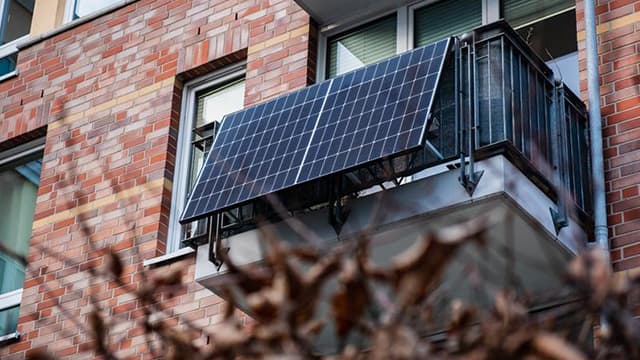
Plug-in solar panels will go on sale in the UK later in 2026. Image source: British Gas
Smart meters, demand-response programs, and connected energy devices allow consumers to actively participate in balancing the grid. Households with rooftop solar panels, home batteries, and electric vehicles are no longer just endpoints. They are nodes—producing, storing, and sometimes feeding energy back into the system. ‘Plug-in’ solar panels are already widely used in households across Europe. In Germany, they are commonplace, with half a million new devices plugged in per year. They involve no installation cost, they are simply plugged into a household socket. Then free solar power can be used directly through any other mains socket to power devices.
The term “prosumer” captures this dual role, but it understates the structural shift underway. In many regions, clusters of these prosumers are now effectively operating as microgrids: localized networks that can generate, store, and distribute energy while remaining connected to the broader system. These microgrids are not centrally managed in the traditional sense. Instead, they rely on continuous streams of data—on usage patterns, storage capacity, and generation levels—contributed by participants across the network. They can be built on blockchain, and operate as DePINs (decentralized physical infrastructure networks).
This is crowdsourcing as critical infrastructure in one of its most technically demanding forms: not voluntary contributions to a platform, but embedded participation in a system whose stability depends on accurate, real-time data and other inputs from its users.
Policy is beginning to reflect this reality. In Austria, for example, regulatory changes now allow individuals to participate in multiple energy communities simultaneously. This is not an experimental pilot; it is a recognition that layered, overlapping forms of participation are necessary for the grid to function effectively.
The dependency is clear. Without the behavioral data, flexibility, and distributed capacity contributed by millions of participants, modern grids would struggle to balance supply and demand in real time. Brownouts and inefficiencies would become more frequent. The intelligence of the grid is no longer centralized—it is distributed across the crowd.
Transportation and Mobility Systems
Transportation infrastructure offers another example of a system quietly rebuilt on distributed participation. For decades, traffic management relied on fixed sensors, cameras, and periodic surveys. These tools provided valuable data, but they were inherently limited: expensive to deploy, geographically sparse, and often outdated by the time they were processed. Today, much of that gap is filled by data generated continuously by drivers themselves.
Navigation platforms aggregate real-time inputs from millions of users to produce up-to-the-minute information on traffic speeds, road conditions, accidents, and closures. This data is not merely supplemental. In many cases, it has become the primary source of situational awareness for both individual drivers and public agencies.
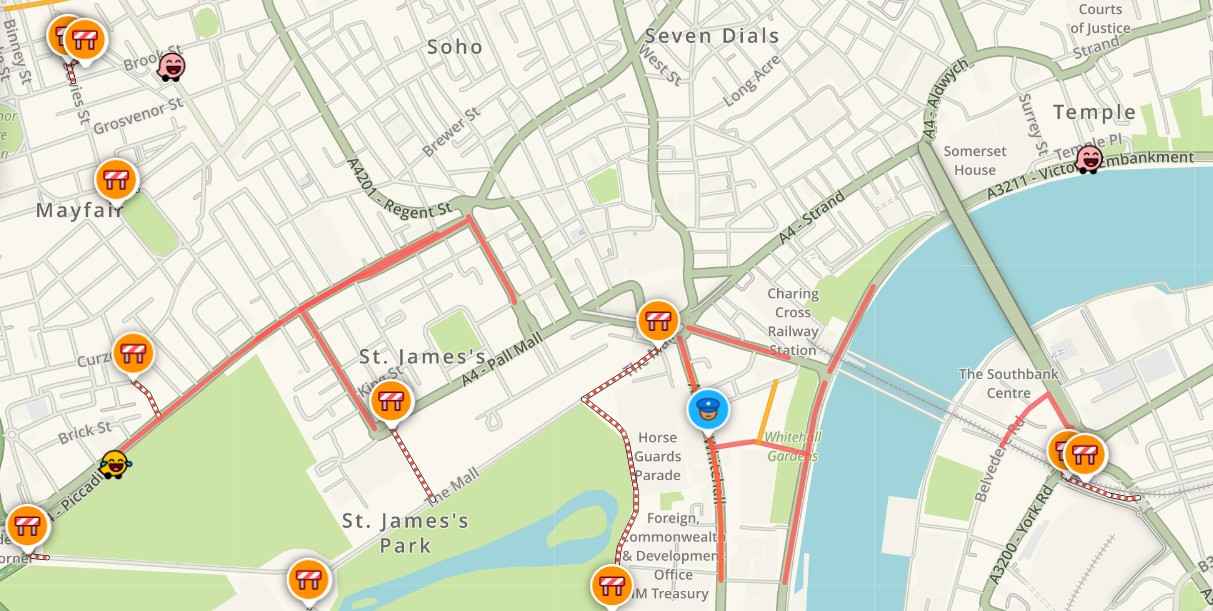
A Waze map showing road closures in central London
The scale is significant. Waze is a community-driven, crowdsourced navigation app acquired by Google in 2013. It reports over 100 million users contributing data across more than 185 countries, logging tens of billions of kilometers. Public agencies have entered into thousands of partnerships to access and exchange this data, integrating it into their operational workflows.
The reason is straightforward: it is neither feasible nor economically justifiable to install and maintain sensors on every road segment. Crowdsourced data fills the gaps that traditional infrastructure cannot cover, providing a level of spatial and temporal resolution that would otherwise be unattainable.
This dependency extends beyond navigation into the emerging domain of autonomous and semi-autonomous vehicles. High-definition maps, which are critical for advanced driver assistance systems, must be constantly updated to reflect changes in road geometry, signage, and lane configurations. Maintaining this level of accuracy through centralized mapping efforts alone would be prohibitively expensive and slow.
Instead, vehicles themselves act as data collectors, using onboard cameras and sensors to capture road conditions and feed that information back into centralized systems. Machine learning models process these inputs, but the raw material comes from a distributed network of participants, often drivers who may be unaware that they are contributing to the maintenance of a global mapping infrastructure.
The result is a transportation system that depends on data it does not fully control. Public agencies have restructured their operations around inputs generated by private platforms and individual users. This creates efficiency gains, but it also introduces new forms of dependency that are characteristic of crowdsourcing as critical infrastructure: powerful, pervasive, and poorly understood by those who rely on it most.
If the flow of crowdsourced data were interrupted, whether due to platform outages, changes in user behavior, or governance disputes, the impact would be immediate. Traffic management systems would lose visibility, routing algorithms would degrade, and the broader network would become less responsive. This brings home that what was once a helpful layer has become foundational.
Climate Adaptation Networks
As climate risks intensify, the need for timely, localized information has become more urgent. Floods, storms, and other extreme events often unfold at scales that exceed the resolution of traditional monitoring systems. Sensors are expensive and sparsely distributed; satellite imagery can be delayed or obscured; official reporting channels may lag behind rapidly changing conditions.
In this context, distributed observation has become indispensable. Crowdsourced data, ranging from structured reports submitted through dedicated platforms to unstructured signals extracted from social media, now plays a critical role in disaster forecasting and response. The concept of “citizens as sensors” is no longer theoretical. It is embedded in the way many early warning systems operate.
The scale of the challenge is immense. Billions of people worldwide are exposed to flood hazards, and improving predictive accuracy can have life-or-death consequences. Research has shown that incorporating crowdsourced observations into forecasting models can significantly enhance their performance.
One study examining typhoon events in China’s Pearl River Delta demonstrated how citizen-reported data could be used to identify and correct errors in numerical models. These corrections, fed back into machine learning systems, improved flood predictions in ways that sensor-based approaches alone could not achieve.
The key advantage is resolution. Professional monitoring networks cannot capture the full complexity of local conditions, whether blocked drainage systems, rapidly rising water levels in specific neighborhoods, or infrastructure failures that alter flow patterns. Distributed human observers can fill these gaps, providing granular, real-time insights that would otherwise be unavailable.
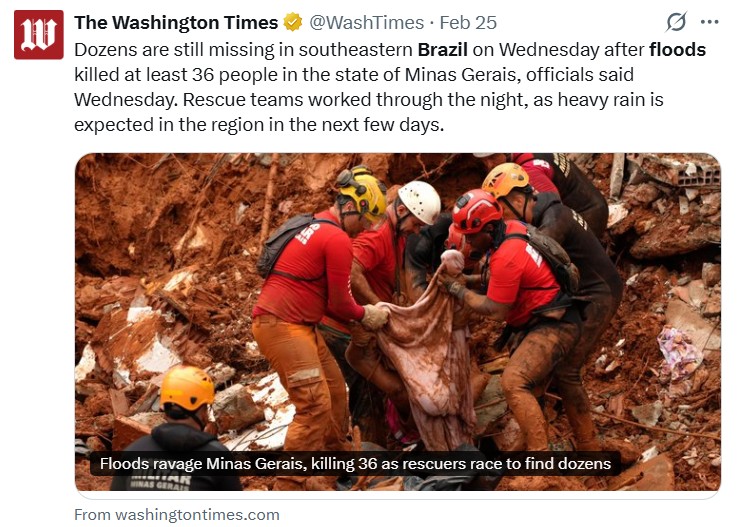
Fatal flooding in Brazil continued in February 2026
Governments are beginning to formalize this role. Following devastating floods in 2024 that affected millions and caused significant loss of life, Brazil launched an interdisciplinary initiative to build community-level disaster information systems. The approach treats residents not merely as recipients of warnings but as active contributors to the data ecosystem that underpins those warnings. It includes routinely scanning social media platforms for relevant keywords, such as landslide, mudslide, landslip, and rockfall. It is, in essence, a formal acknowledgment of crowdsourcing as critical infrastructure for climate resilience.
Early warning systems increasingly integrate multiple data streams: sensor readings, weather forecasts, and crowdsourced inputs. The latter are essential for detecting anomalies, validating models, and guiding response efforts.
Without this layer, the system loses fidelity. Predictions become less accurate, response times increase, and the ability to target interventions diminishes. In a world of accelerating climate risk, these are not marginal losses.
Crowdsourced observation has become a core component of climate adaptation infrastructure—not because it is novel, but because it is necessary.
Supply Chain Visibility and Distributed Production
Global supply chains have grown so complex that no single organization can fully map or monitor them. Production is distributed across thousands of facilities, spanning multiple tiers of suppliers, each subject to changing ownership structures, capabilities, and risks. In this environment, visibility is both essential and elusive.
Crowdsourced data has emerged as a way to address this challenge. Platforms that aggregate information on production locations, supplier relationships, and operational conditions rely on contributions from a wide range of participants: companies, auditors, workers, and other stakeholders.
 One such initiative, Open Supply Hub, has compiled data on over 500,000 unique production locations, drawing from more than 1.6 million records. Maintaining this dataset requires continuous updates, validation, and moderation—tasks that are performed through a combination of automated systems and human contributors. This model reflects a broader shift toward treating supply chain data as a shared resource rather than a proprietary asset. Human-in-the-loop processes ensure that the data remains accurate and current, while open access enables a wider range of actors to analyze and act on it.
At the same time, crowdsourcing is reshaping production itself. The concept of crowdsourced manufacturing involves decentralized networks of producers collaborating across the entire value chain, from design to delivery. Digital platforms enable these networks to coordinate in real time, sharing information on capacity, timelines, and disruptions.
The stakes are high. Organizations have experienced significant losses due to disruptions that originated deep within their supply chains—often in areas where they lacked visibility. In response, many have adopted cloud-based systems that integrate data from multiple sources, including direct inputs from suppliers and logistics partners.
Driver applications provide real-time updates on delivery status, while customer-facing apps enable tracking and feedback. Social networks for supply chain participants allow trading partners to share information on delays, weather events, and operational issues.
This distributed flow of information is what allows modern supply chains to function with a degree of responsiveness that would otherwise be impossible. It is also a clear demonstration of crowdsourcing as critical infrastructure at the commercial scale: quietly sustaining operations that billions of people depend on every day.
But it also introduces new tensions. Data quality becomes a critical concern when inputs come from diverse sources. Competitive sensitivities can limit what participants are willing to share. Questions of governance—who controls the data, who benefits from it—become more complex.
Despite these challenges, the dependency is undeniable. Without the continuous input of crowdsourced data, supply chains would become more opaque, less agile, and more vulnerable to disruption.
Conclusion
Infrastructure is often defined not by what it enables, but by what happens when it is removed. Roads, power grids, and communication networks become visible when they fail, revealing the extent to which modern life depends on them. Crowdsourcing has crossed that threshold.
Across energy systems, transportation networks, climate adaptation efforts, and global supply chains, distributed participation is no longer optional. It is embedded in the core functioning of these systems. Remove it, and the result is not inconvenience but breakdown: grids that cannot balance, roads that cannot be managed, forecasts that cannot be trusted, and supply chains that cannot be seen.
Recognizing crowdsourcing as critical infrastructure has important implications. It raises questions about governance: who owns and controls the data generated by millions of participants? It highlights issues of resilience: what happens if participation declines or becomes uneven? And it brings equity into focus: who benefits from these systems, and who is excluded from contributing to or shaping them?
These are not arguments against the role of crowdsourcing. They are evidence of its importance. We do not ask such questions about systems that are peripheral. Crowdsourcing has moved from the edges to the center. Recognizing it as critical infrastructure is the first step toward treating it with the investment, governance, and protection that infrastructure demands.



0 Comments