



It is widely acknowledged that removing excess CO₂ from the atmosphere is critical for planetary survival and mitigating climate change. The climate tech community is working tirelessly to develop scalable solutions for atmospheric carbon removal to reduce the levels of CO₂ in the atmosphere that were put there in the past decades, and continue to be added to the air we breathe. However, for those of us operating in the crowd and sharing economy, the conversation around decarbonization must extend beyond trapping carbon underground. The real operational frontier lies in leveraging open innovation in carbon capture to transform atmospheric carbon into a reliable, circular resource for industry.
Readers in the crowd economy space are already well-versed in collective intelligence and decentralized networks, so we skip a general introduction to crowdsourcing. Instead, this article explores how Skytree applies these principles directly to deep-tech hardware, specifically, Direct Air Capture (DAC), to tackle a major industrial challenge while building a global community of supporters.
The unseen paradox: A commercial shortage of CO2
While the planet suffers from an excess of CO₂ in the atmosphere, many essential industries face a severe and persistent shortage of commercial-grade CO₂.
Consider Controlled Environment Agriculture (CEA). High-tech greenhouses and indoor vertical farms feed CO₂ into their growing environments to accelerate photosynthesis, boosting crop yields by up to 30%. This yield increase is essential for feeding growing populations while minimizing land and water use, and keeping the cost of food in check. However, conventional commercial CO₂ is typically fossil-derived, either liquid CO₂ transported in diesel trucks from distant industrial plants or flue gas CO₂ produced by burning fossil fuels onsite, creating a contradictory carbon footprint.
Beyond agriculture, the food and beverage industry requires high-purity CO₂ for carbonation, packaging, and preservation. Looking toward the transition to renewable energy, the rapidly expanding sustainable aviation fuel (eSAF) and e-fuels sectors rely on captured CO₂ as a fundamental feedstock. Synthesizing green hydrogen with captured CO₂ produces drop-in replacements for fossil fuels in aviation and shipping. Without a reliable, decentralized source of CO₂, e-fuel scaling stalls.
Historically, commercial CO₂ has been a byproduct of ammonia production and fossil fuel refining. As heavy industries decarbonize and legacy facilities close, commercial CO₂ supply chains are becoming volatile and scarce. Skytree’s decentralized DAC systems address this by enabling businesses to generate their own clean, pure CO₂ directly on-site from ambient air, transitioning industry from a linear "extract and emit" model to a circular "capture and utilize" framework.
Open domain R&D: Co-developing the sorbent loop
Extracting trace amounts of CO₂ from ambient air (where it exists at roughly 420 parts per million) is a complex chemical and mechanical engineering challenge. At the core of Skytree’s technology is a proprietary capture process using a solid sorbent that captures CO₂ as air passes through it, releasing the captured gas when heat is applied.
Optimizing this capture material, the capture process and required machinery requires continuous innovation. Rather than keeping all research behind closed doors, Skytree is working openly with universities, research institutes, and suppliers. Through these open innovation partnerships, we tap into collective intelligence across multiple institutions:
- Agricultural testing with WUR: Working alongside Wageningen University & Research (WUR) in the Netherlands, our DAC units have operated for more than 16,000 hours in real-world greenhouse environments. The (published) field data collected feeds directly back into our engineering loop to optimize system performance for agriculture.
- Arid climate data with GUtech: Through the NoorBridge data collection program with the German University of Technology (GUtech) in Oman, we gather operational data on how sorbent loops perform under high temperatures and arid conditions.
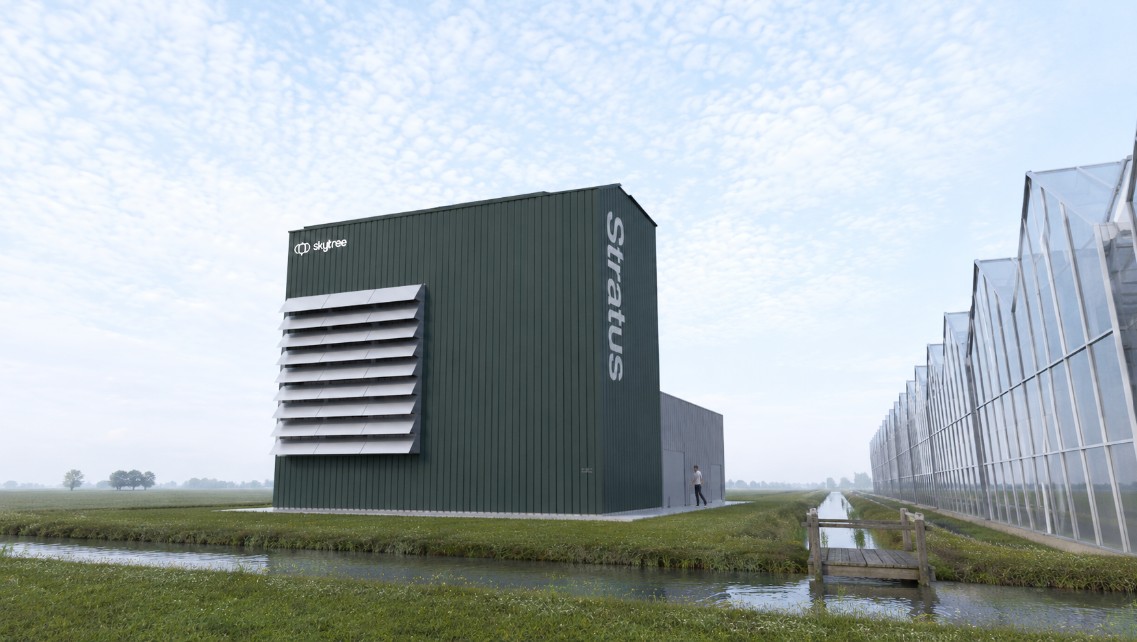
- Power-to-X & eFuels research with Forschungszentrum Jülich: Working with German research institute Forschungszentrum Jülich, our Skytree Stratus system was selected for an innovative Power-to-X research project. The collaboration focuses on capturing atmospheric CO₂ to combine with hydrogen for sustainable e-fuel (methanol) production, spanning initial R&D in Germany and subsequent real-world testing in desert conditions.
- Consortium research with TNO: Within the DAC-PRIMUS framework and the CO₂ Launchpad project alongside Dutch research institute TNO, we co-develop next-generation desorber architectures, retrofits, and thermal testing models.
We also regularly engage university students and young engineers in testing hypotheses, such as evaluating innovative heat exchanger designs or testing retrofitted cooling chambers. By opening our engineering challenges to academic and industrial collaborators, we accelerate system improvements and enable our technology to deliver physical CO₂ directly to commercial off-takers, moving beyond economical reliance on carbon credits alone.
Scaling capital and operations
Commercializing deep-tech hardware requires significant capital and operational momentum. Building on years of research rooted in European Space Agency (ESA) incubation, Skytree successfully raised its Series A round in 2025. This funding enabled us to scale our team to over 100 specialists, expand our manufacturing capabilities in Amsterdam, and deploy commercial units into the field.
However, as we work toward our long-term goal of capturing 10 million tonnes of CO₂ through customer applications by 2030, scaling requires more than just venture capital; it requires broad public engagement and market trust.
Crowdfunding for community and brand ambassadors
As of October 2026, Skytree is preparing its Series B growth capital round to support international expansion and large-scale deployments. As part of this effort, we are inviting retail investors to participate through a convertible loan crowdfunding campaign.
From a purely institutional perspective, managing retail investors alongside large VC funds adds administrative layers. We do not strictly need crowdfunding to meet basic capital requirements. We are doing it because equity crowdfunding transforms passive observers into active brand ambassadors.
By inviting retail investors to participate in our growth via convertible loans, we apply the crowd economy model to our ownership structure. This community of invested supporters provides distinct strategic advantages:
- Grassroots advocacy and word-of-mouth: Climate technology relies on public trust. A global network of retail co-investors creates an active base of ambassadors who share our mission, advocate for decentralized DAC, and build organic awareness across social media and local networks.
- Crowdsourced ideas and feedback: Our retail backers include professionals from agriculture, energy, engineering, and policy. This network provides diverse perspectives, feedback, and real-world insights that inform our market approach.
- Market expansion: Localized supporters often identify regional commercial opportunities, pilot project sites, and policy initiatives that an internal team might otherwise miss.
Conclusion
Solving atmospheric carbon challenges while addressing industrial CO₂ shortages cannot be accomplished by isolated companies working in secret. It requires an open, collaborative model that spans academic research, commercial partnerships, and crowd-backed ownership.
By embracing open innovation in carbon capture, from scientific collaborations coordinated by scientists like Skytree’s Natalia Pienkowska to crowdfunding campaigns that build a dedicated ambassador network, Skytree is demonstrating how collective intelligence can accelerate deep-tech solutions. To reshape the future of our atmosphere, we must also rethink how we build, innovate, and grow together.



0 Comments